
Hear from Our Customers

When the waste line running from your home to your cesspool is failing, everything downstream suffers. Drains back up. Odors appear. You call someone to snake it, it clears for a few weeks, and then it happens again. That cycle doesn’t end until the pipe itself is addressedbecause drain cleaning removes the clog, not the reason the clog keeps forming.
Huntington’s housing stock tells a specific story. The dominant cohort of homes here was built between 1940 and 1969, with nearly a quarter of properties predating 1939. That means the waste lines under most of these homes were installed 55 to 85-plus years ago, using Orangeburg pipe, clay tile, or early cast ironmaterials that were never designed to last this long. When those pipes fail, it’s not bad luck. It’s physics.
The trees are part of the picture too. The established oaks and maples lining streets throughout Huntington Village and the Halesite neighborhood are part of what makes this area feel the way it does. Below grade, those same root systems are the most common cause of line failure in older clay and cast iron pipe. A proper line change with PVC pipeinstalled at the correct slope, sealed at every jointremoves that vulnerability for good. One job, done right, and you stop thinking about it.
We are a four-generation family business that has been doing this work on Long Island for nearly two decades. Not a national chain, not a general plumber who added cesspool work to a service menuwe were built specifically around this trade, in this soil, under these conditions.
That matters in a place like Huntington. The sandy soil along the North Shore shifts. The water table near Huntington Harbor runs higher than most homeowners realize. The post-war housing stock here has its own failure patterns, and knowing those patterns before you dig is the difference between a clean one-day job and a repair that creates new problems. We’ve seen what’s in the ground under these streets. When you’ve been doing this work in one place long enough, that knowledge isn’t a sales lineit’s just what happens.
Every crew member carries proper licensing for Suffolk County. We handle all permits, provide documentation after every job, and give you a written price before any work begins. No surprises after the trench is open.

It starts with a camera inspection. Before any recommendation is made, we run a camera through the line to show you exactly what’s happeningthe root mass, the back-pitched section, the joint that’s collapsed. You see what the crew sees. That’s how you know the work being recommended is the work that actually needs to happen.
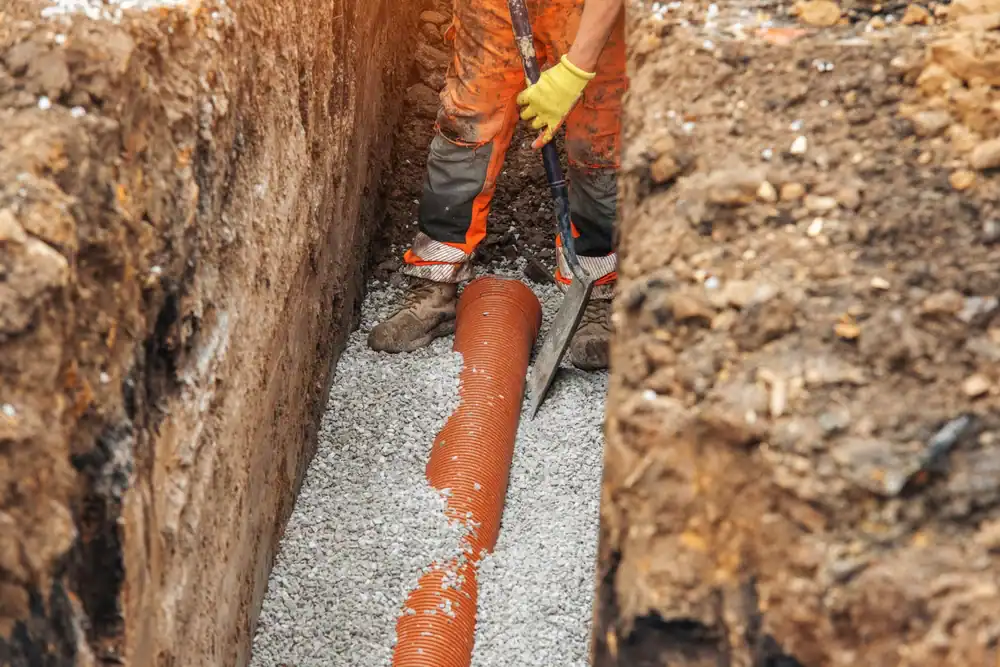
From there, electronic locating equipment maps the pipe path underground. This is what allows for targeted excavationa trench along the pipe run only, typically 18 to 24 inches wide, not a construction zone across your entire yard. For most residential line changes in Huntington, the job is done in a single day. The old pipe comes out, new PVC goes in at the correct slopea minimum of a quarter inch of drop per foot of run, which is a code requirement, not a preferenceand the connection to the cesspool is properly sealed before backfill begins.
Suffolk County requires permits for this type of work, and we handle that process from start to finish. After the job, you receive documentation that satisfies Suffolk County’s requirementswhich matters both for compliance and for your records if you ever sell the home. In Huntington’s real estate market, where pre-sale inspections are thorough and buyers are detail-oriented, that paper trail is worth having.

Ready to get started?
A line change is the replacement of the main waste line that runs from your home to your cesspool or septic tank. It covers the full scope of that pipe runremoving what’s there, installing new PVC at the correct pitch, sealing the connection at the cesspool end, backfilling the trench properly, and compacting so the ground settles cleanly. You can reseed or replant right away.
For homes in Huntington Village and the surrounding areas like Halesite and Cold Spring Harbor, the most common scenarios involve Orangeburg or clay pipe that has cracked, shifted, or been overtaken by root intrusion. In some cases, the original pipe path needs to be rerouted slightly to avoid a tree root system or meet current Suffolk County code requirements. We handle both straightforward replacements and rerouted installationsthe camera inspection at the start of the job determines which approach is right for your specific situation.
Worth knowing: Suffolk County banned new cesspool installations in July 2019, and grant funding is now available through programs authorized under the Suffolk Water Quality Restoration Act signed in May 2024. If your line change is part of a larger system upgrade, we can walk you through what grant options may apply to your situation and help navigate the paperwork. Most homeowners in this area don’t know those programs exist until a contractor mentions them.
The most reliable sign is a problem that keeps coming back. If you’ve had the line snaked more than once in the past year or two and the drains are slow again, the cleaning isn’t fixing the underlying issueit’s just clearing a symptom. Other signs include sewage odors in the yard, soft or wet ground along the pipe path, or gurgling sounds from multiple fixtures at once.
In Huntington specifically, homes built before 1970 are the most likely candidates. The clay and Orangeburg pipe installed during that era wasn’t designed to last 60 or 70 years, and most of it has. A camera inspection is the only way to know for certain what’s happening inside the pipe. We won’t recommend a line change without showing you what the camera found first. If the pipe can be repaired rather than replaced, that’s what we’ll tell you.
This is one of the most common concerns from homeowners in Huntington Village, and it’s a fair oneproperties here often have established gardens, mature plantings, and hardscape that took years to build. The honest answer is that a line change requires a trench along the path of the pipe, but that trench is typically 18 to 24 inches wide. It’s not a full yard excavation. Electronic locating equipment maps the pipe before any digging starts, so the crew knows exactly where to work and can avoid areas that don’t need to be accessed.
Once the new pipe is in and the trench is backfilled and compacted correctly, the ground settles within a few weeks. You can reseed or replant immediately. The disruption is real but containedand a properly backfilled trench causes far less long-term damage than a pipe that’s been slowly leaking into the soil for years.
New installations use PVC pipe, which is the current standard for residential waste lines. PVC doesn’t corrode, handles Long Island’s sandy soil movement without cracking, and resists root infiltration at joints in a way that clay and cast iron simply can’t. The life expectancy of properly installed PVC pipe is 50 to 100-plus yearswhich means a line change done right today is likely done for the life of the house.
This is a meaningful difference from the materials that are failing in Huntington’s older homes. Orangeburg pipe was commonly used through the 1970s and was never designed to last more than a few decades. Clay tile cracks from soil shifting and is particularly vulnerable to the kind of root intrusion you see in neighborhoods with mature tree canopy. Cast iron corrodes over time. When we replace a line, the new pipe is installed at the correct slopea quarter inch of drop per linear footand verified before the trench is closed.
Yes. Because Huntington is located in Suffolk County, any significant work on a private waste system falls under the Suffolk County Department of Health Services and Article 6 of the Suffolk County Sanitary Code. A line changewhich modifies the connection between your home and your cesspool or septic systemrequires a permit before work begins.
We handle the permit process from start to finish. You don’t need to navigate the Suffolk County SCDHS paperwork on your own. After the job is complete, you receive documentation of the work performed, which satisfies the county’s record-keeping requirements. That documentation also matters if you sell your homeit’s the paper trail that shows a buyer and their inspector that the work was done properly, by a licensed contractor, under permit. In Huntington’s competitive real estate market, that kind of clean record can prevent delays at closing.
It’s one of the most common causes of line failure on Long Island’s North Shore, and Huntington is specifically identified as one of the communities most affected by it. The reason is straightforward: the streets and yards here have 60- and 70-year-old trees growing over 60- and 70-year-old clay and cast iron pipe. Fine root tendrils enter through hairline cracks or deteriorating joints, then grow. What starts as a thread becomes a mass. What starts as a slow drain becomes a fully blocked line.
The frustrating part is that root intrusion doesn’t announce itself until the blockage is severe enough to cause a backup. A drain cleaning will clear the roots temporarily, but they grow backusually faster each time, because the pipe opening gives them a clear path. A camera inspection shows exactly how far the intrusion has progressed and whether the pipe wall is still structurally sound. If it’s not, a line change with PVC is the long-term answerPVC resists root infiltration at joints in a way that older materials don’t.
There is, and most homeowners in Huntington don’t find out about it until they’re already in the middle of a repair. Suffolk County has active grant programs for qualifying homeowners upgrading failing wastewater systems, and the Suffolk Water Quality Restoration Actsigned in May 2024authorized additional county-level funding for this type of work. Depending on the scope of the project and eligibility, grants can offset a significant portion of the cost.
These programs exist largely because Long Island gets its entire drinking water supply from underground aquifers, and aging cesspools and failing waste lines are a documented source of nitrogen contamination in the groundwater. Suffolk County has a financial and public health interest in getting these systems upgraded, which is why the grant programs are real and fundednot theoretical. We can walk you through what’s available based on your specific situation and help with the paperwork. It’s worth asking before you assume you’re covering the full cost out of pocket.
Other Services we provide in Huntington